


School Harmony


"That is not respectful."
By: Guiding Dreams Team
2025
7 min read
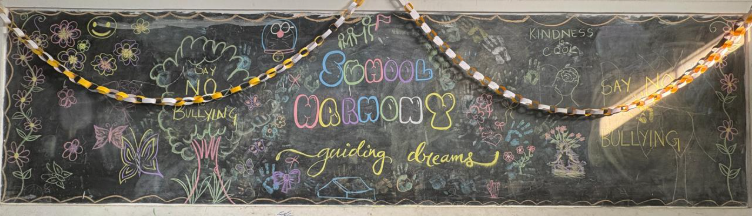
School Harmony: The Day a School Chose to Stand Together
If you are reading this for the first time, here is the context.
After implementing Classroom Harmony at Natun Fatasil Town High School, something important became clear:
Classroom change is powerful. But culture is bigger than a classroom.
Corridors shape culture. Assemblies shape culture. Playgrounds shape culture. Language shapes culture.
So we asked a deeper question: What would it mean to design harmony at the whole-school level?
Not just class by class. But school-wide.
Why Children's Day Became the Moment
We did not "launch" School Harmony randomly. We chose Children's Day.
Not for performance. But for alignment.
Children's Day already carries meaning. It already gathers everyone. It already creates attention.
So instead of treating it as an event, we treated it as an opportunity.
An opportunity to model what the school could become.
From Multiple Assemblies to One Shared Space
Previously, assemblies were separated. Different groups. Different flows. Different energies.
On Children's Day, we intentionally designed one unified assembly.
Students. Teachers. Parents.
All present in one shared space. Not as spectators. But as participants.
And something subtle but powerful happened. The posture of the school changed.
Student Leadership in Action
School Harmony is not adult-driven alone.
The 22 student leaders who had been growing through Classroom Harmony were given real responsibility.
They:
- Managed transitions
- Guided peers
- Modeled respectful behaviour
- Anchored team norms
They were not symbolic representatives. They were structural anchors.
When students take visible responsibility, culture stabilises. Not through authority. Through ownership.
Introducing Shared Language: KiVa-Inspired Thinking
At the school level, bullying cannot be addressed reactively. It must be named clearly.
So School Harmony integrated KiVa-inspired principles:
- Bullying is a group phenomenon
- Bystanders shape outcomes
- Silence can reinforce harm
- Collective responsibility matters
We introduced shared language. Simple. Clear. Age-appropriate.
Children learned to say:
"That is not respectful."
"We don't leave someone alone like that."
"We can repair this."
When language changes, intervention changes. When intervention changes, culture shifts.
What Was Different That Day
Children's Day did not feel louder. It felt aligned.
Music flowed without chaos. Transitions were smoother. Students managed movement. Teachers facilitated instead of controlling. Parents were present without tension.
And the phrase that emerged naturally was: "One School. One Family."
This was not branding. It was a lived experience.
Why School Harmony Matters
Classroom Harmony builds micro-structure. School Harmony builds ecosystem alignment.
It integrates:
- Student leadership
- Shared behavioural language
- Anti-bullying clarity
- Assembly coordination
- Ritual alignment
- Adult modeling
Culture cannot be demanded. It must be designed.
And when alignment spreads beyond one classroom, a school begins to breathe differently.
If You Are a School Leader
If you are thinking: "Our classrooms are fine, but the overall culture feels fragmented," School Harmony may be your next step.
We work with:
- Student leadership circles
- Assembly redesign
- Anti-bullying integration
- Shared language development
- Parent inclusion
- Whole-school ritual alignment
We do not impose. We co-design with your leadership.
If You Are a District or Institutional Partner
If you are looking to strengthen school climate across multiple campuses, School Harmony is designed to be:
- Structured
- Trainable
- Replicable
- Low-burden
And aligned with public education systems.
Related Stories
Tags
Field Journal
Classroom Harmony
Assam
Zero to One
Mindfulness

Related Stories
Zero to One — A Journey Begins at Natun Fatasil Town High School
Today marked "Day 0" — a formal beginning to a journey that we hope will inspire resilience, connection, and a sense of belonging.

Classroom Harmony: Designing Structure That Reduces Stress
Emotional safety must be built into the daily rhythm — not added as an extra activity. Learn how we redesigned classroom structure at Natun Fatasil Town High School.
School Harmony: The Day a School Chose to Stand Together
After implementing Classroom Harmony, we asked: What would it mean to design harmony at the whole-school level? The answer unfolded on Children's Day.
When Students Chose to Stand Up
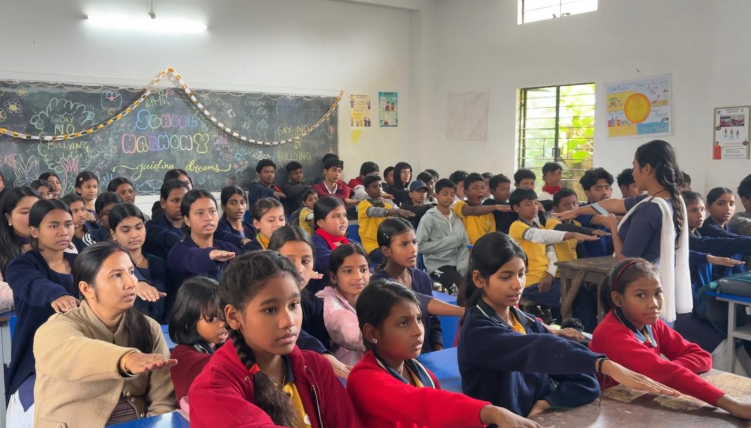
When we began integrating KiVa-inspired thinking into School Harmony, something unexpected happened. Students who admitted past behaviour became allies.
Shillong: When Teachers Became Practitioners
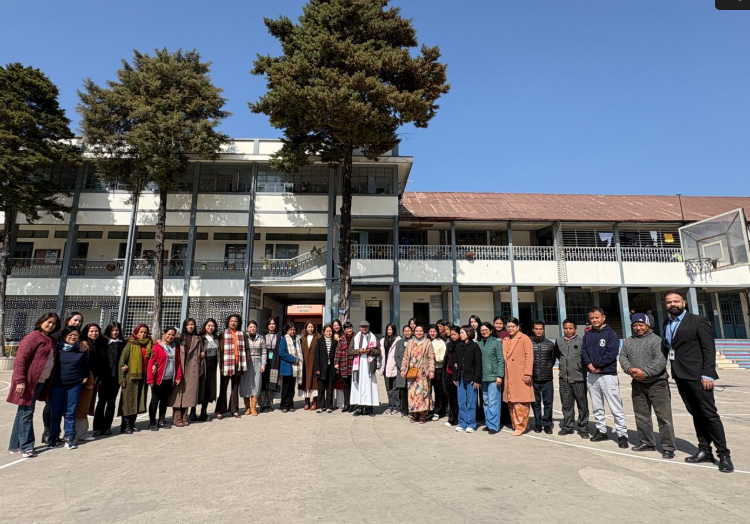
Our first cross-state step. St. Anthony's LP School in Meghalaya showed us what happens when preparation meets practice.
Harmony Hub: What Happens After the School Bell Rings?
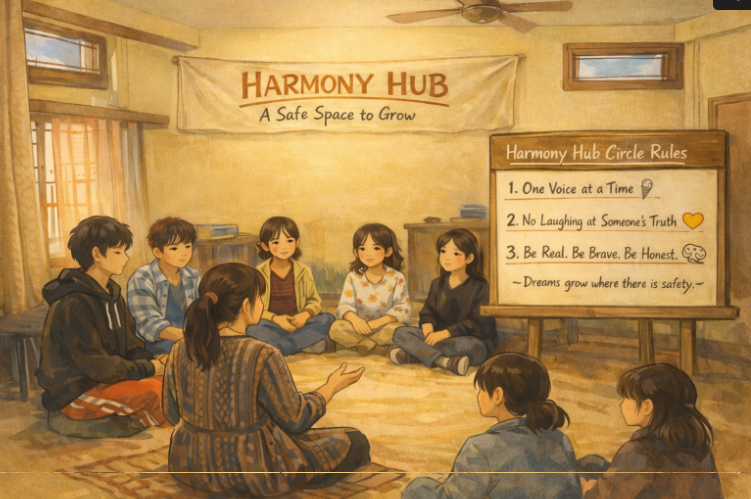
School culture does not end at dismissal. Harmony Hub is structured continuity — a bridge between school and home.