


Classroom Harmony


By: Guiding Dreams Team
2025
6 min read
Classroom Harmony: Designing Structure That Reduces Stress — For Teachers and Students
If you walk into most classrooms, you will see effort. Teachers explaining. Students responding. Energy moving. Instructions repeated. Transitions negotiated.
Nothing is "wrong." But something is often missing.
Structure that supports everyone.
Classroom Harmony began at Natun Fatasil Town High School with one guiding principle: Emotional safety must be built into the daily rhythm — not added as an extra activity.
We did not start with lectures on empathy. We started with observation.
- How does class begin?
- How are groups formed?
- What happens when expectations are unclear?
- How often does a teacher repeat instructions?
- What happens when small disruptions compound?
These are not behaviour problems. They are structural gaps.
So we redesigned the rhythm.
The Role of the Good Behavior Game (GBG)
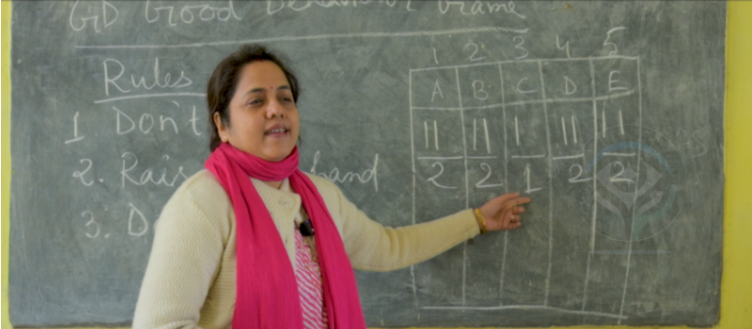
The Good Behavior Game was introduced not as a tool of control, but as a system of shared accountability.
Teams are formed intentionally. Rules are visible and co-owned. Expectations are clarified once. Tracking is collective — not individual humiliation. Celebration is shared.
When implemented correctly, three things happen:
- Teachers repeat instructions less.
- Students remind each other.
- Transitions become faster and calmer.
This is not magic. It is structure.
And structure reduces cognitive load.
When teachers are not constantly correcting, they can teach. When students know expectations clearly, they regulate collectively.
GBG is not about silence. It is about coordination.
What We Observed Over Time
At Natun Fatasil:
- Teachers reported lower repetition fatigue.
- Students began self-organising within teams.
- Classroom energy became more predictable.
- Emotional escalation reduced naturally.
Not because someone imposed fear. Because responsibility was distributed.
Classroom Harmony does not depend on personality. It depends on design.
Why This Matters for Public Schools
Public schools operate under high pressure:
- Large classrooms
- Limited resources
- Diverse student needs
- Administrative demands
Any model that increases burden will fail.
Classroom Harmony was designed to:
- Integrate into the existing timetable
- Require minimal additional material
- Be trainable within one workshop cycle
- Be scalable across multiple sections
This is not a program layered on top. It is a structural enhancement.
The Theory Behind It (Simply Put)
When adults pause and observe before reacting, they shift from reaction to design.
That is Theory U in practice.
Observe. Reflect. Redesign. Integrate.
Classroom Harmony is not an intervention. It is an alignment process.
If You Are a Teacher
If you feel like you are repeating the same instructions every day, if transitions feel draining, if classroom energy feels unpredictable — Classroom Harmony can give you structure without increasing workload.
We begin with one training, then guided practice, then integration support.
You do not need to change who you are. You need a system that supports you.
If You Are a School Leader
If you want classroom culture improvement that is measurable, low-burden, and scalable — Let's design Classroom Harmony in your school.
We will:
- Train your teachers
- Co-design routines
- Support implementation
- Monitor early-stage shifts
Because when structure improves, learning deepens naturally.
Related Stories
Tags
Field Journal
Classroom Harmony
Assam
Zero to One
Mindfulness

Related Stories
Zero to One — A Journey Begins at Natun Fatasil Town High School
Today marked "Day 0" — a formal beginning to a journey that we hope will inspire resilience, connection, and a sense of belonging.
Classroom Harmony: Designing Structure That Reduces Stress
Emotional safety must be built into the daily rhythm — not added as an extra activity. Learn how we redesigned classroom structure at Natun Fatasil Town High School.

School Harmony: The Day a School Chose to Stand Together
After implementing Classroom Harmony, we asked: What would it mean to design harmony at the whole-school level? The answer unfolded on Children's Day.

When Students Chose to Stand Up
When we began integrating KiVa-inspired thinking into School Harmony, something unexpected happened. Students who admitted past behaviour became allies.

Shillong: When Teachers Became Practitioners
Our first cross-state step. St. Anthony's LP School in Meghalaya showed us what happens when preparation meets practice.
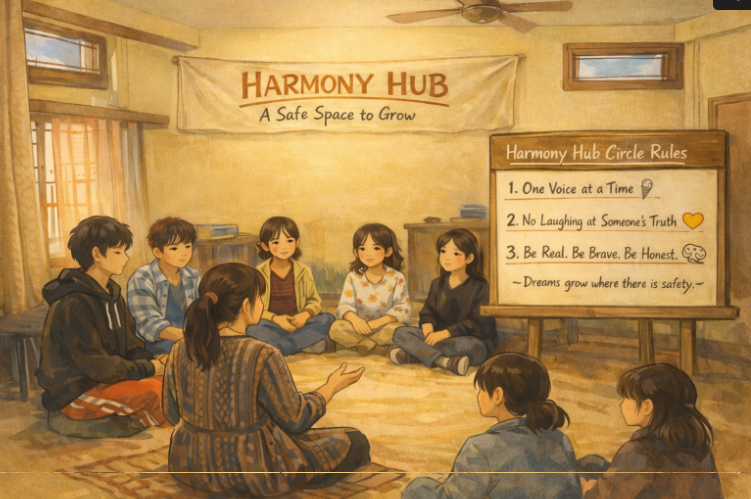
Harmony Hub: What Happens After the School Bell Rings?
School culture does not end at dismissal. Harmony Hub is structured continuity — a bridge between school and home.